
Google Ads Smart Bidding Strategy: Everything You Need to Know (2026 Guide)
Smart bidding is the single biggest lever most advertisers pull without actually understanding what is happening
behind the scenes.
You turn it on, Google’s machine learning takes over, and either your results improve or your budget quietly
disappears. There is rarely a middle ground, and that is exactly why so many business owners end up frustrated
and searching for answers.
If you have ever asked why my smart bidding is not converting or which Google Ads automated bidding
strategy should I actually use, you are in the right place.
This guide breaks down every major smart bidding strategy Google offers in 2026, when to use each one, how
the algorithm actually learns, and the practical mistakes that quietly drain budgets. It is written from real
account management experience, not recycled theory.
Quick Answer:
Google Ads Smart Bidding is a set of automated, machine-learning bidding strategies, Maximize Conversions,
Maximize Conversion Value, Target CPA, and Target ROAS, that set a unique bid for every auction using real-time signals like device, location, time of day, and search intent. Most accounts with accurate conversion
tracking and enough data get better results from smart bidding than from manual bidding, but the strategy has to match the accounts data maturity and business goal.
Let’s face it, most articles on this topic either oversimplify smart bidding into a just trust the algorithm pep
talk, or bury you in jargon that never actually helps you make a decision. This one is different.
We are going to walk through the mechanics, the real 2026 platform changes, the data, the trade-offs, and the
exact checklist our team uses internally before switching any client account onto a new bidding strategy.
What Is Smart Bidding in Google Ads:
Smart bidding is a subset of automated bidding strategies in Google Ads that uses machine learning to set the
actual cost-per-click bid for every single auction your ads compete in. Instead of a human manually raising or
lowering bids based on gut feeling, Googles algorithm evaluates dozens of contextual signals in real time, a
process Google calls auction-time bidding.
Think about it this way. A manual bidder can realistically consider maybe three or four factors before setting a
bid, like device, time of day, and past performance. Googles smart bidding system evaluates signals including
device type, location, time of day, remarketing list membership, browser, operating system, and actual auction-
time context, all within milliseconds.
That scale of calculation is simply not something a human strategist can replicate manually, no matter how
experienced they are. This is where automation genuinely earns its place. The goal is not to remove human
strategy from the account, it is to hand off the repetitive, high-frequency bid-by-bid decisions to a system built
to process that volume, while the human strategist focuses on structure, creative, targeting logic, and
interpreting the results.
Why Google Ads Smart Bidding Strategies Matter More in 2026:
Manual CPC bidding used to be the default because advertisers did not trust automation with their budgets, and
frankly, in its early years, that skepticism was fair. The technology has matured considerably since then, and
2026 brought two changes worth knowing about before you touch your account settings.
Naming change: Starting in June 2026, Google renamed “Maximize Conversions with a Target CPA” to simply
Target CPA, and “Maximize Conversion Value with a Target ROAS to Target ROAS. The bidding behavior itself
did not change, only the label in your dashboard, so do not panic if your account suddenly shows a different
strategy name.
Bid Target Adjustment Tool: From August 17, 2026, Google is tightening how target-based strategies respond to
budget changes on campaigns marked “Limited by budget” If your account has been quietly overperforming a
stated Target CPA or Target ROAS, you may see performance shift toward your literal target rather than your
recent actual results, unless you update your target using the new Bid Target Adjustment Tool first.
Here is the catch though. Smart bidding does not automatically mean better results. It means better results only
when the account has enough conversion data, clean tracking, and a bidding strategy that actually matches the
business goal. An account with broken conversion tracking that switches to Target CPA is not fixing a problem, it
is asking a confused algorithm to optimize toward the wrong signal, which usually makes performance worse,
not better.
At DizUp Technologies, we have watched this play out across client accounts spanning the UK, US, Singapore,
India, and UAE. The pattern is consistent everywhere. Accounts that succeed with Google Ads smart bidding
treat it as a system that needs to be fed clean data and given time, not a switch you flip and forget.
The Core Google Ads Automated Bidding Strategies Explained
Google groups its smart bidding strategies under a few clear goals: conversions, conversion value, and target
return metrics. Below is a breakdown of each strategy, what it optimizes for, and who it actually fits in 2026.
-
Maximize Conversions
This strategy tells Google to spend your entire daily budget in a way that gets you the highest possible number
of conversions, without a specific cost target. It is often the first automated strategy advertisers try because it
requires the least setup and no conversion history to get started.
It works best for accounts that are newer to smart bidding and still building a conversion history, or for
businesses where volume matters more than a strict cost ceiling in the early stage. The trade-off is that without
a target, the algorithm can sometimes spend aggressively to hit volume, which is worth watching closely in the
first two to three weeks.
-
Maximize Conversion Value
Instead of chasing the highest count of conversions, this strategy optimizes for the highest total value of
conversions within your budget. This matters enormously for ecommerce accounts and any business where not
all conversions are worth the same amount.
A lead form fill and a completed six-figure purchase are not the same event, and this strategy is built to
understand that difference if your value tracking is set up correctly.
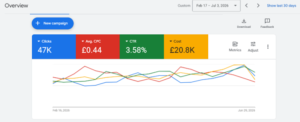
A UK-based client account driving 47K clicks at a 3.58% CTR, the kind of volume that makes a value-based strategy worth testing.
Target CPA (formerly Maximize Conversions with a Target CPA)
Target CPA tells Google the average amount you are willing to pay for a conversion, and the algorithm adjusts bids auction by auction to hit that average across the campaign. It does not mean every single conversion costs exactly that amount, some will cost more, some less, but the average should trend toward your target over time.
This strategy needs real data before it performs well. Google generally recommends at least 30 conversions in the last 30 days before setting a Target CPA. Fewer than that, and the algorithm is working with too little signal to calibrate properly, so it is usually safer to stay on Maximize Conversions until you cross that threshold.
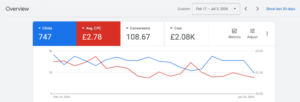
A smaller client account converting at roughly £19 per lead across 747 clicks, a realistic candidate for Target CPA once conversion volume builds further.
Target ROAS (formerly Maximize Conversion Value with a Target ROAS)
Target ROAS is the value-based counterpart to Target CPA. You tell Google the return you want for every rupee
or dollar spent, expressed as a percentage, and the algorithm bids to hit that average return.
This is the strategy most ecommerce and high-ticket service accounts eventually graduate toward, but Google
recommends at least 50 conversions with accurate value data in the recent 30-day window before setting a
target. It is also the strategy that punishes messy value tracking the hardest. If your conversion values are not
accurate, Target ROAS will optimize precisely and confidently toward the wrong outcome.
Quick Decision Guide
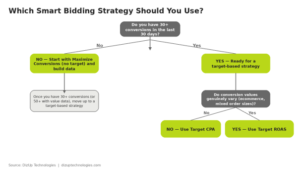
A simplified decision flow for choosing your first (or next) smart bidding strategy.
Smart Bidding Strategies Comparison Table:
| Strategy | Optimizes For | Best Fit | Data Needed |
| Maximize Conversions | Highest conversion volume within budget | New accounts, lead-volume goals | Low, can start early |
| Maximize Conversion Value | Highest total conversion value | Ecommerce, mixed-value conversions | Moderate, accurate value tracking |
| Target CPA | Average cost per conversion | Lead gen with a known acceptable cost | 30+ conversions in last 30 days |
| Target ROAS | Return per unit of spend | Ecommerce, high-ticket services | 50+ conversions with value data |
| Manual CPC | Bids you set by hand | Very early accounts, thin data, tight control needs | None |
How Many Conversions Do You Need Before Switching to Smart Bidding:
This is one of the most common questions we get on discovery calls, and it deserves a direct answer rather than a vague “it depends.”
- Maximize Conversions: No minimum, can be used from day one, though performance stabilizes faster with more data.
- Target CPA: Google recommends 30+ conversions in the last 30 days for reliable calibration.
- Target ROAS: Google recommends 50+ conversions with accurate value data in the last 30 days.
- Below these thresholds: Stay on Maximize Conversions (or Maximize Conversion Value) and revisit target-based strategies once volume catches up.
In practice, more data leads to better performance well beyond these minimums. Treat them as a floor, not a finish line.
How Google’s Smart Bidding Algorithm Actually Learns:
Every automated bidding strategy goes through what Google calls a learning period. During this window, the algorithm is testing bid ranges and gathering data on how different bid amounts perform across different auction contexts.
Here is a question I, Pragati founder of DizUp Technologies, notifies my clients during onboarding calls. “The biggest mistake I see accounts make is panicking during the learning period and manually adjusting bids or budgets before the algorithm has had a real chance to calibrate. This means every time you make a significant change, the learning period effectively resets, and you are back to square one.”
This single behavior, restarting the learning phase repeatedly out of impatience, is responsible for more underperforming smart bidding campaigns than any algorithm limitation.
Signals the Algorithm Uses:
The system evaluates a wide range of real-time and historical signals for every auction, including:
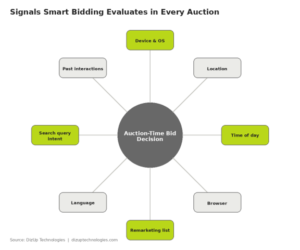
No human strategist, no matter how skilled, can weigh this many variables per auction in real time. This is precisely the gap smart bidding is designed to close.
How Long Does the Learning Period Actually Take:
The honest answer is that it depends heavily on conversion volume, not on a fixed number of days.
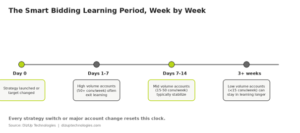
- High-volume campaigns (50+ conversions per week): Often exit learning in 5 to 7 days.
- Mid-volume campaigns (15 to 50 conversions per week): Typically take 7 to 14 days.
- Low-volume campaigns (under 15 conversions per week): Can remain in learning for three weeks or longer, and some never fully stabilize without structural changes.
Rule of thumb for making changes: no more than once every two to three weeks, and in increments of 10 to 15 percent when adjusting a target. Frequent changes keep an account in a permanent state of re-learning, which quietly wastes budget.
Portfolio Bid Strategies and Smart Bidding Exploration:
Here are the two features worth understanding once you move past single-campaign bidding decisions.
Portfolio bid strategies group multiple campaigns under one shared learning model instead of optimizing each campaign in isolation. This consolidates conversion data, which helps Google’s algorithm learn faster, particularly useful for accounts running several similar campaigns (for example, multiple service-area or product-line campaigns) that individually would each struggle to hit the conversion thresholds above.
Smart Bidding Exploration temporarily relaxes your Target CPA or Target ROAS to test new traffic segments the algorithm might otherwise ignore. It is worth testing on mature accounts, but keep an eye on your targets during the exploration window since performance can wobble while it runs.
Neither feature is a substitute for account structure and clean data. Both work best layered on top of an account that already has the fundamentals right.
Common Mistakes That Disrupt Google Ads Smart Bidding:
Broken or Incomplete Conversion Tracking:
If your conversion tracking is not firing correctly, or if you are counting conversions that do not actually represent real business value, the algorithm is optimizing toward noise. This is, without question, the most common root cause behind “why is my smart bidding not converting” style problems. If you are dealing with this exact issue, our detailed breakdown on why your Google Ads may not be converting walks through the diagnostic steps in more depth!
Switching Strategies Too Frequently:
Every strategy switch triggers a new learning period. Accounts that jump between Maximize Conversions, Target CPA, and Target ROAS every few days never give any single strategy enough runway to actually optimize.
Setting Unrealistic Targets:
A Target CPA or Target ROAS set far outside what the account has historically achieved forces the algorithm into an impossible position. It will either fail to spend the budget at all, or it will chase the target in ways that hurt overall volume.
Ignoring Account Structure:
Smart bidding does not fix a poorly structured account. Campaigns with mismatched ad groups, irrelevant keywords, or unclear conversion goals will underperform regardless of which bidding strategy sits on top of them.
Underfeeding the Algorithm:
Smart bidding strategies that rely on targets need enough conversion volume to calibrate. Applying them too early, before an account has met the 30 or 50 conversion thresholds above, often produces worse results than simply starting with Maximize Conversions.
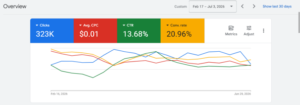
A mature client account converting at nearly 21% with a $0.01 average CPC, an example of how efficient smart bidding gets once tracking and structure are solid
Pre-Launch Checklist Before Switching to Smart Bidding:
- Conversion tracking is verified and firing correctly on the actual goal action
- Conversion values are accurate, if using a value-based strategy
- Account has met the relevant conversion threshold (30+ for Target CPA, 50+ for Target ROAS)
- Realistic targets are set based on historical account data, not guesswork
- Budget is sufficient to support the learning period without starving campaigns
- No major account changes are planned for the two to three weeks following the switch
- Stakeholders are aligned on giving the strategy adequate time before judging results
A Real Account Example:
One pattern I see repeatedly involves accounts that moved to Target ROAS too early, before value tracking was properly configured. In one such case, a client’s ecommerce account was passing incomplete conversion value data to Google, which meant the algorithm was optimizing toward a partial and misleading picture of actual revenue.
Once value tracking was corrected and the account was given a fresh, undisturbed learning period, performance stabilized within the following weeks and began trending toward the account’s realistic historical return.
I have seen this scenario more commonly than most advertisers realize. I have seen people blaming the algorithm when the real issue is almost always upstream, in the data being fed to it. For such scenarios, my only suggestion is “Fix the input, and the output tends to follow.”
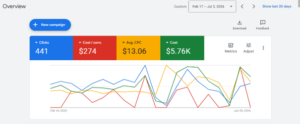
A lead-generation client account with a $274 cost per conversion, a reminder that Target CPA has to reflect what an account can realistically achieve before it is set.
Manual Bidding vs Smart Bidding: Which Should You Choose
Manual bidding still has a place, particularly for very new accounts with little to no conversion history, accounts spending under roughly $2,000 a month, or highly specialized campaigns where a strategist wants granular control over specific keywords while conversion tracking is still being built out.
For most established accounts with reliable conversion tracking, Google Ads smart bidding strategies outperform manual bidding simply because of the auction-level precision the algorithm can apply that a human cannot replicate at scale. The right choice depends on your account’s data maturity, your goals, and how much oversight you are able to provide during the learning phase.
| Manual CPC | Smart Bidding |
| You decide every bid | Google decides every bid |
| Limited adjustments | Auction-time adjustments |
| Requires continuous optimisation | Uses machine learning |
| Based largely on historical data | Uses real-time auction signals |
| Time-consuming | Highly automated |
If you are unsure which stage your account is at, a professional audit is usually faster and cheaper than months of trial and error. Our PPC management services include exactly this kind of diagnostic work before any bidding strategy changes are recommended.
Final Thoughts
Smart bidding is not a magic switch, and it was never meant to be one. It is a genuinely powerful system when it is fed clean conversion data, given realistic targets, and allowed to run through its learning period without constant interference.
Whether you are exploring Google Ads smart bidding for the first time, comparing Adwords smart bidding options against manual control, or troubleshooting a Target ROAS campaign that is not hitting its numbers, the fundamentals stay the same.
Fix your tracking first, choose the strategy that matches your actual business goal and current conversion volume, and give the algorithm the time and data it needs to work.
If you would rather have a certified expert audit your account instead of guessing, DizUp Technologies can help. I Pragati Saini, a Google Ads certified specialist with more than five years of hands-on experience managing ad spend for clients across the UK, US, Singapore, India, UAE, and more can help you handle the exact smart bidding challenges covered in this guide, like I did for dozens of live campaigns.
Get in touch with DizUp Technologies today for a free smart bidding audit and see exactly where your account stands!
Frequently Asked Questions
How long does the smart bidding learning period take?
Most campaigns take roughly one to two weeks to exit the learning phase. High-volume campaigns (50+ conversions a week) can exit in 5 to 7 days, while low-volume accounts can take three weeks or longer since the algorithm needs enough data points to calibrate reliably.
Does smart bidding work for small budgets?
It can, but small budgets combined with low conversion volume make the learning period slower and less stable. Maximize Conversions is often a more forgiving starting point than a tight Target CPA in these cases, and manual CPC remains reasonable for accounts under roughly $2,000 a month.
Can I switch between smart bidding strategies whenever I want?
Technically yes, but every switch resets the learning period. It is best to commit to a strategy for at least two to three weeks before evaluating whether to change it.
Why did my costs increase after switching to smart bidding?
This usually happens during the learning period as the algorithm tests bid ranges, or it can signal that your target is set unrealistically low relative to your account’s historical performance. It is worth reviewing conversion tracking accuracy first.
Is Target ROAS better than Target CPA?
Neither is universally better. Target ROAS fits businesses where conversion values genuinely vary, like ecommerce. Target CPA fits businesses where most conversions carry similar value, like many lead generation models.
Should a new Google Ads account start with smart bidding immediately?
Generally yes, in the sense that Maximize Conversions can run from day one, but hold off on Target CPA or Target ROAS until the account has met Google’s recommended conversion thresholds (30+ for Target CPA, 50+ for Target ROAS).
Is Enhanced CPC still an option in 2026?
No. Enhanced CPC was fully retired in March 2025. Accounts should use Maximize Conversions or a target-based strategy instead.
What is the minimum conversion volume Google recommends before setting a target?
Google recommends at least 30 conversions in the last 30 days before setting a Target CPA, and at least 50 conversions with accurate value data before setting a Target ROAS.
About the Author
DizUp Technologies, a Google Ads certified expert with 5+ years of experience managing and scaling ad accounts of clients across the UK, US, Singapore, India, UAE, and more. He specializes in smart bidding strategy, campaign structuring, and PPC performance troubleshooting for growth-stage businesses.